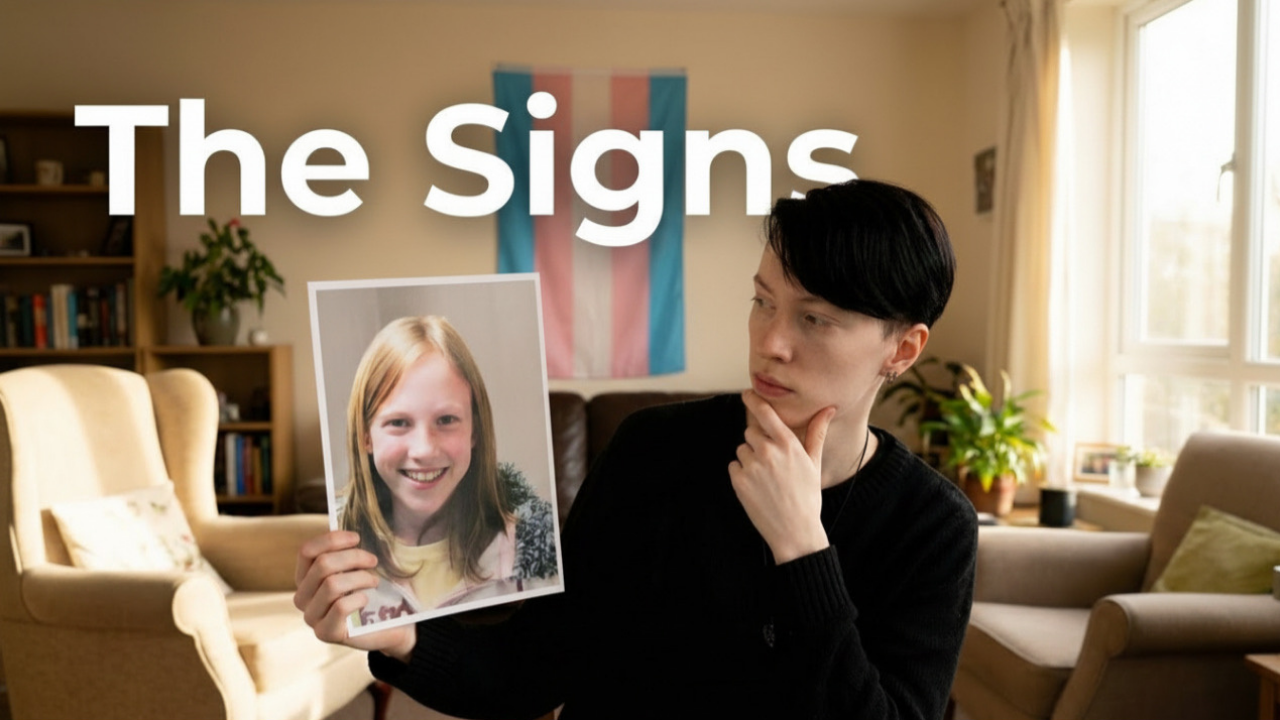
Discovering I’m trans wasn’t instant or dramatic, but slow, confusing, and deeply personal. Looking back, the signs were always there—I just didn’t have the words yet.
Watch the companion video here!
Growing Up With a Feeling I Couldn’t Name
When I was a kid, I didn’t really notice anything was “off.” I was just doing my thing—running around, playing outside, getting muddy, building forts. In hindsight, the signs were there, but at the time I didn’t have the language for them. I just always felt wrong in a way I couldn’t explain, a quiet discomfort that followed me everywhere.
I thought of myself as a tomboy. Clothes never felt gendered to me—they were just clothes. Even when other people described me as feminine, that label never matched how I saw myself.
Trying to Find Myself Through Style
As I got older, that discomfort stuck around. When I started looking for my own style as a teenager, I always gravitated toward men’s fashion. I loved how it looked—on them. When I tried to recreate it on myself, I felt pressure to soften it, feminize it, make it “acceptable.”
At the time, I didn’t realize that this was part of discovering I’m trans. I just knew I felt closer to myself when I imagined being seen differently.
The Thought I Tried to Ignore
One day in early high school, I walked past a mirror and thought, Maybe I’m trans.
I immediately pushed that thought away. I had absorbed so many negative messages about what being trans meant that I didn’t want it to be true.
But once the thought existed, it never fully went away.
Googling for Answers
Eventually, I did what a lot of confused teens do—I Googled everything. I went through long lists of LGBTQ terms, reading definitions over and over, trying to find myself in the words. Gender fluid felt like the closest match at first, even though I didn’t fully understand what I was feeling yet.
That period of questioning was messy and emotional, but it was a necessary part of discovering I’m trans, even if I didn’t fully claim it yet.
Dysphoria and Self-Realization
Once I understood what dysphoria was, it hit hard. What used to be a vague discomfort suddenly had a name, and that made it impossible to ignore. I struggled, had breakdowns, and spent time with a counselor who at least understood what I was talking about.
With that understanding came bigger questions—about hormones, top surgery, and what transition could look like for me.
Letting Myself Imagine a Future
After graduation, I put a lot of things on hold while I focused on surviving adulthood. I used labels like non-binary or genderqueer because they felt safer while I figured things out. But even when I told myself transition wasn’t an option, I never stopped researching, watching videos, or imagining myself on the other side of it all.
That’s when I realized something important: discovering I’m trans wasn’t just about labels—it was about allowing myself to want a future where I felt whole.
Choosing to Be Myself
Eventually, I accepted that for me, transitioning isn’t optional. Not because every trans person has to transition—because they don’t—but because I can’t keep living disconnected from myself. I want people to see me as I truly am.
I’m still in the process of coming out and moving forward, but I’m happier now than I’ve ever been.
A Note for Anyone Still Figuring It Out
If you’re questioning, confused, or scared, please know this: you don’t have to rush. Take your time. Sit with the questions. Let yourself grow into the answers.
Discovering who you are takes patience—but it’s worth it.