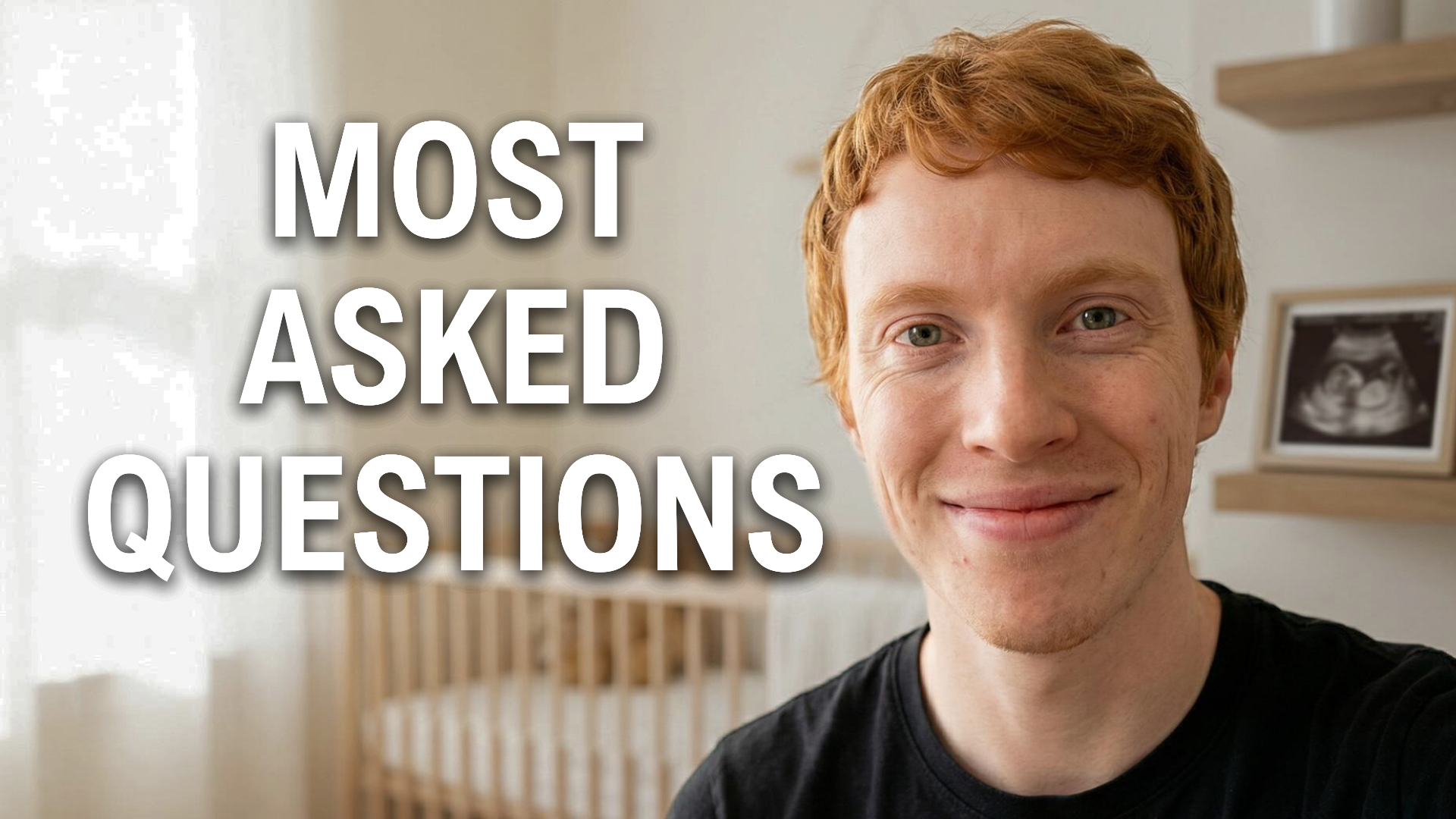
I always knew I was different, but I didn’t figure out I was a trans man until high school. Even then, I never wanted to carry my own kids. But I did it for my wife. That’s a reality the world doesn’t always get. So today, I’m going to answer your most-asked questions about my journey. We’re going to get into the raw, the real, and the complicated. I want to talk about it, because this experience, my experience, is about love, family, and identity, all at once. And it’s a story that deserves to be told, understood, and respected.
The “Why” – The Decision to Carry
Let’s start with the question I get more than any other: “Why? Why would you, as a man, choose to get pregnant?”
The answer is simple, but maybe not in the way you expect: I did it for my wife. For me, carrying a child was never part of the plan. But for her it was was everything. My identity as a man is solid. But my body has capabilities that not all men have, and I realized that carrying our child could be the bridge to making her dream our reality.
My wife and I talked about all our options, but this felt right for our family. It was an intentional choice. While some research suggests up to 30% of pregnancies among trans men are unintended, the vast majority are planned, just like ours. The decision wasn’t about going “back.” It was about moving forward, using the body I have to create the family we’ve always dreamed of. It was about choosing to become a father in a way I never expected. It’s a path that isn’t widely understood, and it highlights the need for better emotional counseling, which isn’t common enough for people like me.
The “How” – Navigating the Medical Process
This brings us to the next question: “Okay, but how?”
The first step was one of the hardest things I’ve ever had to do: I stopped taking testosterone. T is what makes me feel like myself. As a trans man it’s my voice, it’s my body, it’s me. So, choosing to stop was this huge mental and physical leap of faith. I was willingly stepping away from the thing that affirms my identity every single day.
Then came the waiting. My cycle returned after just a few months, and it took nine months from the time I stopped T to when we got pregnant. It was a stressful wait, full of uncertainty. But once it did, we were able to start trying. My wife, who is also trans, and I were so lucky that we were able to conceive naturally, using my own eggs.
But that “how” wasn’t just about the physical process. It was about trying to find medical support that actually supported us. We were mostly on our own, finding providers who didn’t just stare at us blankly. The “how” isn’t just medical; it’s navigating a system that wasn’t built for you.
The Biggest Struggle – Gender Dysphoria During Pregnancy
Now for the question that gets to the heart of it: “Did being pregnant worsen your gender dysphoria?”
Yes, it did, but maybe not as badly as I had feared. Gender dysphoria is that painful disconnect between your mind and your body, and I’d worked for years to lessen it. While pregnancy can be a trigger for dysphoria, it wasn’t as overwhelming as I thought it might be. But I did still have it.
The physical changes were the main challenge. After being off testosterone, I didn’t like looking in the mirror and seeing my features soften. It felt like I was seeing a woman again. I’d had top surgery before getting pregnant, which was a huge relief, but about halfway through the pregnancy, some of the leftover breast tissue began to swell. I really didn’t like that my chest was starting to look a little more feminine again.
Then there were the medical appointments. Procedures like pelvic exams can cause intense anxiety, because they focus on parts of the body that are already a source of pain. It’s a clinical necessity that can feel like a violation of your identity. You’re trying to focus on your baby’s health, while every fiber of your being is screaming that this body isn’t yours. There were days I wanted to skip appointments just to avoid being misgendered—a real risk that causes some to avoid care. It’s an exhausting internal war: the joy for your child fighting the dysphoria that’s trying to erase you.
Navigating the World as a Pregnant Trans Man
This leads to the external challenges: “How did people treat you?”
Navigating the world as a visibly pregnant man is like being a walking spectacle. Strangers stare, whisper, and point. Your existence is an anomaly, and curiosity often overrides politeness.
But the most stressful interactions are often in the healthcare system. Prenatal care is built entirely around “women” and “motherhood”—from the forms to the posters on the wall. Researchers call this “institutionalized cisnormativity”—the assumption that everyone is the gender they were assigned at birth. It makes you feel invisible and isolated.
I spent nine months in waiting rooms filled with cisgender women, feeling like an intruder. It can be an incredibly lonely experience. I had providers who fumbled with pronouns and nurses who made awkward jokes. While I eventually found a supportive team, many trans men face discrimination or have to educate their own doctors. Negative experiences are terrifyingly common, which is why affirming care is so critical. It can be as simple as using the right name and pronouns. Just one provider seeing you as you—a man, a father-to-be—can make all the difference.
The Birth – A Moment of Truth
“So, what was giving birth like?”
Each time was so different. With my first son, I was laboring at the hospital for about eight hours. I was only misgendered once, and another nurse immediately corrected her.
My second son’s birth was more traumatic. I remember screaming in pain and in a panic about whether I would need a C-section. The doctor calmed me down, and it only took about thirty minutes of labor for my second son to be born.
In both of those moments, when they placed my sons on my chest, something shifted. All the months of dysphoria and anxiety started to fade. The focus became singular: get this baby here safely. The labels, the pronouns, the confused stares, the dysphoria—it was all just noise. All I could hear was his cry. All I could feel was his tiny body against mine. I wasn’t a medical anomaly anymore. I was a father. Holding my son. That moment was the resolution to every “why” and every “how.” It was the answer.
Life After – Fatherhood and the Future
The questions don’t stop there. People ask, “What about postpartum? Is the dysphoria gone?”
For a trans dad, there are added complexities. Decisions around feeding the baby can bring dysphoria right back. My chest tried to produce milk using the small amount of leftover breast tissue, but since I have had top surgery, my nipples are no longer functional. Because I couldn’t breastfeed, this caused a lot of swelling, and for weeks I had a constant, burning pain. And I had a powerful urge to restart testosterone to feel like myself again, but that had to be balanced with being a new parent.
The dysphoria still lingers some days. I see the changes on my body and remind myself why they’re there. But now, that feeling isn’t just pain; it’s a part of my story as a father.
Being a dad is more than I ever expected. It’s dirty diapers and 3 a.m. feedings. First smiles and gummy laughs. It’s a love so immense it physically hurts. My family may not look like the ones in the picture frames at the store, but it’s built on the same foundation of love, commitment, and a relentless desire to give my children the best life possible.
This is my story, but there are so many others out there. If you want to follow our journey as a family, you can find us on Instagram.
And if this resonated with you, please consider sharing it. The more we can normalize different paths to parenthood, the more we can educate others and create a safer, more understanding world for families like mine.
Being a man who gave birth doesn’t make me any less of a man. It just makes me a father who had a unique role in his children’s creation. My identity is not fragile. It was strong enough to hold space for this incredible, life-altering experience. My family is real. My fatherhood is real. And my love for my sons is the most real thing in the world. Thank you for listening.